
What Is Fascia? The Hidden Network Behind Your Pain, Posture, and Performance
You wake up stiff. Your neck won't quite turn all the way. Your lower back feels locked. You stretch, you move around, and eventually things loosen up, but the next morning it starts all over again. Sound familiar?
Most people chalk this up to age, a bad mattress, or just the price of being busy. But there's a good chance the real culprit is something most people have never thought about: their fascia.
In Episode 12 of the Easewell Podcast, Dr. Cara sits down with Dedric Carroll, massage therapist, clinical researcher, and founder of Empirical Knead in Atlanta, Georgia, for a deep conversation about fascia, bodywork, lymphatic drainage, kinesiology, and the science behind manual therapy. Dedric brings over 17 years of industry experience and more than a decade of clinical research to every conversation, and his perspective on connective tissue health is genuinely eye-opening.
This post breaks down what they discussed and why understanding fascia might be one of the most useful things you can do for your long-term health and mobility.
What Is Fascia?
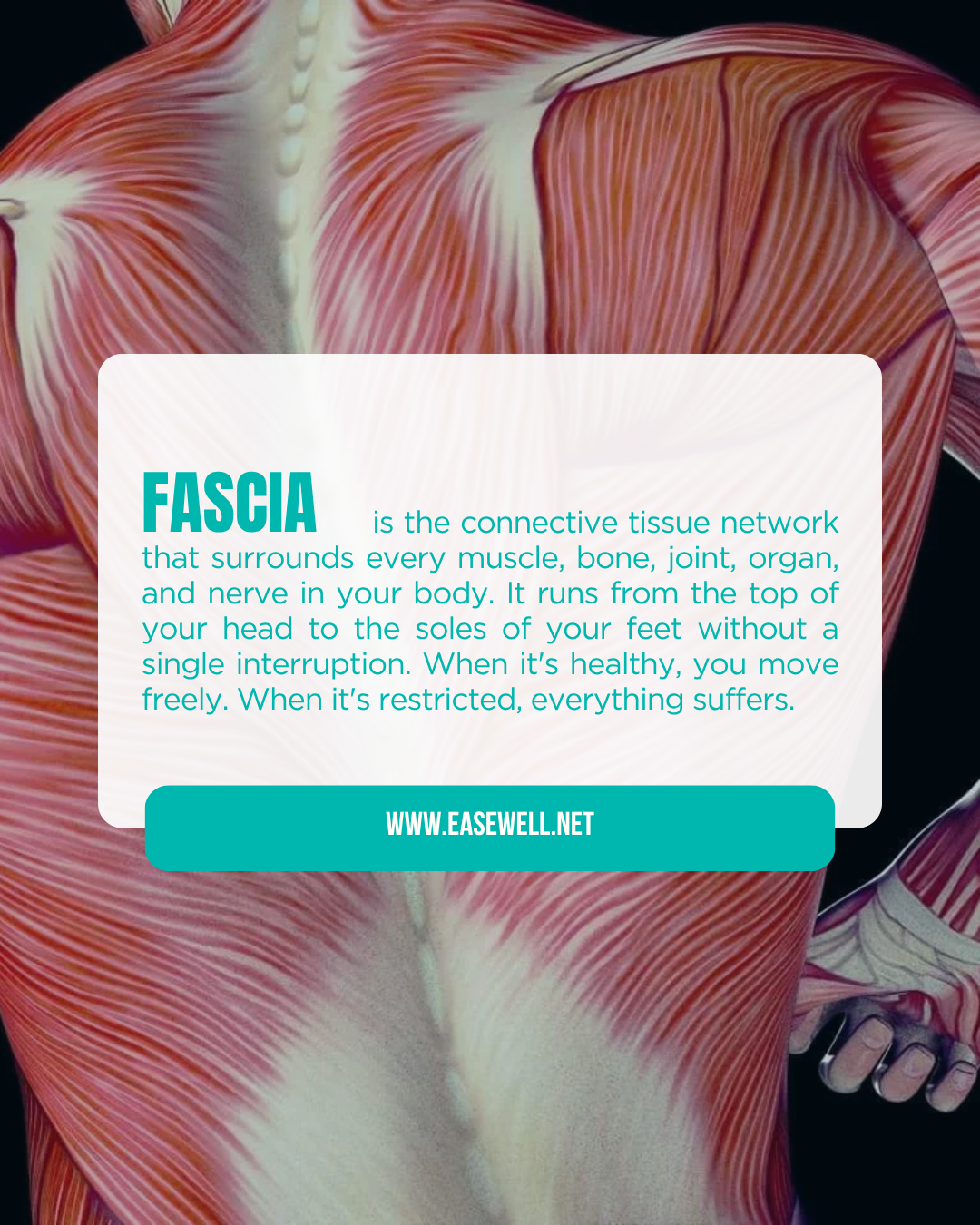
Fascia is a continuous network of connective tissue that surrounds, separates, and supports virtually everything inside your body: your muscles, bones, joints, organs, nerves, and blood vessels. It exists in layers, running from the top of your head to the soles of your feet without a single interruption.
The easiest way to picture it: imagine peeling an orange. That thin, white, slightly stringy layer between the peel and the fruit? That's a rough approximation of what fascia looks like. It's that ubiquitous, that fibrous, and that interconnected. Now imagine that same kind of web existing inside your entire body, wrapping every muscle fiber, threading between joints, linking your shoulder to your hip, your neck to your lower back. That's fascia.
For a long time, fascia was largely dismissed in medical and anatomical study, it was the tissue researchers cut through to get to what they were actually looking at. It was considered structural filler, nothing more. But that thinking has shifted dramatically. We now understand that fascia is not passive packaging. It's a dynamic, living tissue loaded with sensory nerve endings, capable of contracting, communicating, and responding to everything from physical stress to hydration levels to emotional tension.
Dedric Carroll's practice at Empirical Knead is built on this understanding. His work in Kinesis Myofascial Structural Integration focuses specifically on how the fascial system connects the body as one continuous chain, not a collection of independent muscles and joints, but a single integrated structure where tension in one area reliably affects areas far removed from the original source.
Why Fascia Matters More Than Most People Realize
Here's what makes fascia so significant: it doesn't just connect structures. It communicates between them.
Fascia contains more sensory receptors than muscle tissue itself. That means your brain gets a significant portion of its information about where your body is in space, what researchers call proprioception, from your fascial network. When fascia is healthy and hydrated, those signals are clear. When it's restricted or dehydrated, that communication becomes distorted. You lose coordination. Your body compensates. And compensation, held long enough, becomes dysfunction.
This is why a tight calf can contribute to knee pain. Why restricted hip flexors show up as lower back tension. Why the way you hold your jaw can pull on your neck, shoulders, and thoracic spine. The fascial lines of the body don't follow the neat, compartmentalized logic of anatomy charts. They run continuously through the whole system.
Fascia also plays a central role in posture. The position your body defaults to: the way you hold your head, the rounding of your shoulders, the tilt of your pelvis, is largely a fascial story. Muscles get the credit and blame for posture, but it's the connective tissue that holds the pattern in place. You can strengthen a muscle all you want, but if the fascial environment around it is restricted, you're fighting an uphill battle.
What Happens When Fascia Becomes Restricted
Healthy fascia is hydrated, flexible, and responsive. It glides easily between layers, allowing muscles to slide past each other smoothly and joints to move through their full range of motion.
Restricted fascia is the opposite. It becomes dense, dehydrated, and sticky - almost like plastic wrap that has been crumpled and re-stretched too many times. When that happens, the tissue loses its gliding quality, layers that should move freely start to adhere to each other, and the whole system starts compensating.
The most common causes of fascial restriction include:
Prolonged static postures. Sitting at a desk for hours, looking down at a phone, sleeping in the same position night after night, all of these hold the fascia in shortened, compressed positions for extended periods of time. Over months and years, it begins to adapt to those positions structurally. This is exactly what Dedric describes when discussing the tech neck epidemic: it's not just muscle tightness causing forward head posture, it's the fascial system reorganizing itself around a habitual position.
Injury and trauma. When the body experiences injury: a car accident, a sprain, a surgical incision, fascia lays down scar tissue as part of the healing response. That scar tissue is less organized and less elastic than healthy fascia, and it can create pulling patterns that affect areas far from the original injury site.
Repetitive movement patterns. Athletes, manual laborers, and anyone whose work involves repeated movements in one direction are especially vulnerable. The fascia adapts to the movement pattern it gets most, thickening and shortening along those lines.
Dehydration and inactivity. Fascia requires fluid to stay pliable. Its matrix is largely composed of water-loving proteins, and when hydration is low or when movement is minimal, the tissue loses that fluid content and becomes more rigid.
The symptoms of restricted fascia aren't always obvious. They can look like chronic tightness that stretching never fully resolves. Reduced range of motion. Muscle fatigue that seems disproportionate to the effort involved. Recurring pain in the same location despite treatment. Poor posture that returns no matter how often you correct it. Discomfort that moves around rather than staying fixed in one place. Because the fascial system is so interconnected, restriction in one area creates a kind of body-wide tension pattern and chasing the symptom without addressing the source rarely produces lasting relief.
The Connection Between Fascia, Movement, and Recovery
If there is one thing that comes through clearly in Dedric Carroll's work and philosophy, it's this: the fascia responds to movement. Not just any movement; informed, varied, intentional movement that takes the tissue through its full range rather than reinforcing the same limited patterns over and over.
Fascia remodels itself based on the mechanical demands placed on it. Load it regularly through its full range and it stays organized, hydrated, and responsive. Keep it compressed and still, and it adapts by becoming more dense and less mobile. This is why rest alone is rarely the answer for fascial restriction, passive recovery without movement doesn't give the tissue the mechanical input it needs to reorganize.
This is also why chiropractic care and bodywork work well together. A spinal adjustment addresses the structural alignment and nervous system communication that fascia depends on to function properly. But without also addressing the fascial environment, the tissue that holds those structural patterns in place, adjustments may not hold as long or as effectively as they could. The two modalities genuinely complement each other, working on different but deeply interconnected layers of the same system.
For anyone recovering from a car accident, a sports injury, or chronic postural strain, this matters a lot. The adjustment resets the structure and the nervous system. The myofascial work helps re-educate the connective tissue around that new position so the body can actually maintain it.
How Bodywork Supports Fascial Health
Dedric's practice, Empirical Knead, specializes in Kinesis Myofascial Structural Integration, a form of manual therapy that works with the body's connective tissue to address postural and movement imbalances at their structural root. This is different from a traditional relaxation massage. The work is targeted, informed by a detailed understanding of how fascial lines run through the body, and oriented toward creating lasting structural change rather than temporary relief.
In Episode 12, Dedric and Dr. Cara also discuss several other bodywork approaches that support fascial health:
Myofascial release involves applying sustained, gentle pressure into fascial restrictions to allow the tissue to soften and lengthen. Unlike aggressive deep tissue work, effective myofascial release often uses relatively light pressure held over time, because fascia responds to sustained load, not force. Forcing dense tissue often causes it to contract further in response.
Lymphatic drainage is a gentle manual technique that supports the movement of lymphatic fluid through the body's vessels. Fascia plays a structural role in lymphatic health, the lymph vessels run through the fascial layers, and when fascial tissue becomes restricted, it can impede lymphatic flow. Supporting lymph drainage helps reduce inflammation, clear metabolic waste, and support immune function.
Cupping therapy uses suction to create a decompressive force in the tissue, the opposite of most manual therapy, which applies compression. By lifting the tissue layers rather than pressing into them, cupping can help break up adhesions between fascial layers, improve local circulation, and encourage the separation of layers that have become stuck together. Many people recognize the circular marks left by cupping as a sign that the tissue was being worked on at a deeper level than surface massage reaches.
Kinesiology and movement re-education form another cornerstone of Dedric's approach. It's not enough to release a fascial restriction if the movement pattern that created it remains unchanged. Part of the work involves helping clients understand how they're moving, where their habitual patterns are breaking down, and how to retrain their neuromuscular system to support better alignment going forward. The tissue may be re-educated in the session, but the client needs the body awareness and the functional exercises to reinforce those changes between sessions.
Simple Ways to Support Your Fascia Every Day
You don't have to be a bodywork client to start supporting your fascial health. These are practical, accessible habits that make a real difference over time:
Hydrate consistently. Fascia is a hydrophilic tissue, it holds and requires water to stay pliable. Chronic mild dehydration is one of the most underappreciated contributors to fascial stiffness. Aim for consistent water intake throughout the day, not just when you're thirsty.
Move more, and move differently. The fascia adapts to the movements it gets. If you sit in the same position for eight hours and then do the same workout every day, you're reinforcing the same fascial patterns. Introduce variety: walk, swim, dance, stretch in directions you don't normally go. The tissue needs to be taken through multiple planes of motion to stay responsive.
Stretch slowly and hold longer. Fast, bouncing stretches don't give fascia the time it needs to respond. Because fascia has a time-dependent quality, meaning it requires sustained load to release, slow, held stretches of 90 seconds or more are more effective for fascial change than quick dynamic stretching.
Prioritize daily walking. Walking is one of the best fascial exercises that exists. It takes the body through cross-pattern movement, loads the fascial lines alternately from foot to shoulder, and keeps the tissue fluid and organized. Even 20 to 30 minutes of walking daily has measurable effects on connective tissue health over time.
Incorporate mobility work. Hip circles, thoracic rotation, shoulder rolls, neck movements through full range, these aren't just warm-up exercises. They're fascial maintenance. Do them daily, not just before a workout.
Use a foam roller or massage ball thoughtfully. Self-myofascial release tools can be useful, but slower and more sustained is more effective than rolling fast and hard. Find a tender spot, pause on it, breathe, and let the tissue respond before moving on.
Invest in professional bodywork. There are layers of the fascial system that self-care simply cannot reach. Regular massage therapy, myofascial work, or structural integration sessions, particularly with a practitioner like Dedric Carroll who understands the fascial system in depth, can address restrictions that accumulate over years and don't respond to surface-level approaches.
Prioritize sleep and recovery. Tissue repair and fascial remodeling happen primarily during sleep. Consistent, quality rest is not optional for fascial health.
Fascia and Chiropractic Care: A Natural Partnership
At Ease Wellness Chiropractic, we see the relationship between the spine, the nervous system, and the fascial network every single day. Spinal misalignment affects the fascial environment around the spine. Fascial restriction can pull vertebrae out of optimal alignment. The two systems are in constant conversation.
Chiropractic adjustments work by restoring proper alignment and removing interference from the nervous system — allowing the body to communicate and function as it's designed to. When combined with intentional fascial care, whether through bodywork, movement, or the daily habits outlined above, the results are consistently better and longer lasting.
This is precisely why Dr. Cara and Dedric Carroll have developed such a strong mutual respect for each other's work. Chiropractic and myofascial bodywork aren't competing approaches — they're complementary pieces of a whole-body wellness strategy.
The Bigger Picture
Fascia is one of those subjects that, once you understand it, changes how you think about your entire body. That recurring tension isn't just a tight muscle. That chronic postural issue isn't just laziness or weakness. That pain that moves around and never quite responds to treatment might be telling you something about your connective tissue that nobody has thought to address.
Understanding fascia means understanding your body as a whole system rather than a collection of isolated parts. It means recognizing that mobility isn't just about flexibility, that posture isn't just about strengthening your core, and that recovery isn't just about resting.
It means paying attention to the tissue that holds everything together.
Listen to the Full Episode
Catch Episode 12 of the Easewell Podcast — What Is Fascia? And Why Should You Care? on YouTube to hear Dr. Cara and Dedric Carroll's full conversation about fascia, lymphatic drainage, cupping, kinesiology, and the science of bodywork.
To connect with Dedric Carroll and learn more about his work at Empirical Knead in Atlanta, visit empiricalknead.com.
Ready to experience whole-body chiropractic care at Ease Wellness? We serve the greater Atlanta area across eight locations. Book your appointment today.
Frequently Asked Questions
What is fascia? Fascia is a continuous network of connective tissue that surrounds and connects every muscle, bone, joint, organ, and nerve in your body. It runs from head to toe without interruption, functioning as the body's internal scaffolding and communication network.
Can fascia cause pain? Yes. When fascia becomes restricted, dehydrated, or develops adhesions between layers, it can create tension patterns that cause pain, limit mobility, and affect areas far from the original restriction. Chronic, unexplained, or migrating pain is sometimes a fascial issue that isn't addressed by treating only the local symptom.
How do you keep fascia healthy? Staying well hydrated, moving consistently through varied movement patterns, stretching slowly and holding longer, walking daily, and investing in regular bodywork are the most effective ways to maintain healthy fascia. Avoiding prolonged static postures and prioritizing sleep and recovery also matter significantly.
What is myofascial release? Myofascial release is a manual therapy technique that applies sustained, gentle pressure into areas of fascial restriction to allow the tissue to soften and release. It differs from deep tissue massage in that it focuses specifically on the connective tissue rather than the muscle belly, and tends to use slower, more sustained pressure rather than aggressive force.
Does chiropractic care help support fascia health? Chiropractic care and fascial health are closely related. Spinal adjustments restore structural alignment and nervous system function, which directly affects how the fascial system can respond and remodel. Many patients find that combining chiropractic care with myofascial bodywork produces better and longer-lasting results than either approach alone.
